Champs de fracture
March 19th – May 2nd 2026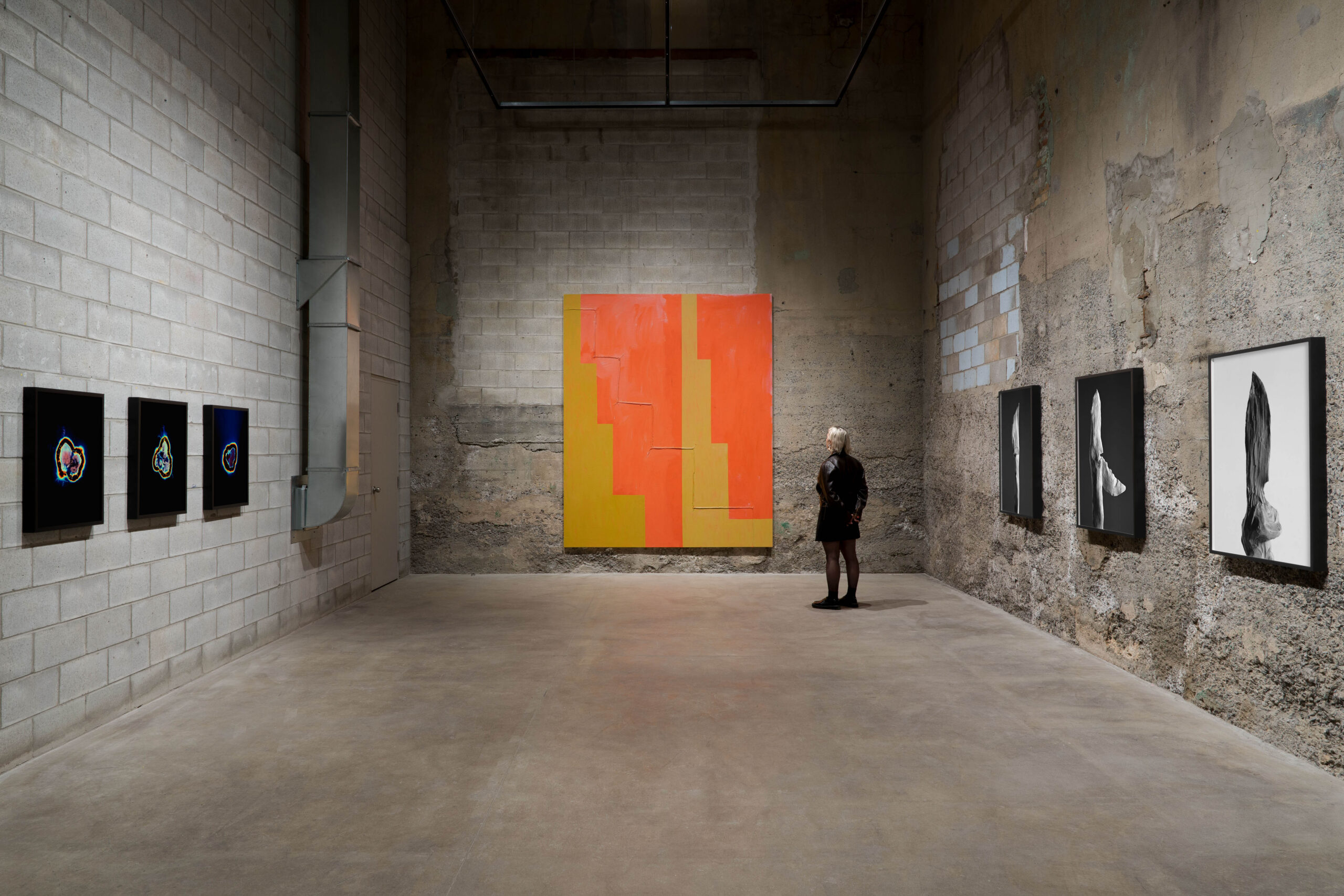
March 19 to May 2, 2026
Vernissage: Thursday, March 19, 5PM to 8PM
Marie-Michelle Deschamps
Dawit L. Petros
Jeremy Shaw
Erin Shirreff
Shaan Syed
Bradley Ertaskiran is pleased to present Champs de fracture, showcasing the work of Marie-Michelle Deschamps, Dawit L. Petros, Jeremy Shaw, Erin Shirreff, and Shaan Syed. Across painting, mixed-media, and photography, the exhibition brings together practices and images that slice, scar, and segment, using dissection and division, materially or conceptually, to explore instability and perception.
Shaan Syed’s monumental two-toned painting Double Minaret (with Sewn Steps) 1 (2018) centres on the stepped (and split) motif of the minaret, a recurring symbol in the artist’s practice that nods to his upbringing and illustrates his ongoing preoccupation with uniting disparate halves. The painting’s textured surface is the result of a sort of reverse excavation process, in which material is built up then scraped away, revealing the dried layers beneath. There is a palpable tension throughout the composition, as the minaret’s diagonal forms are interrupted by a great scar or divide, the result of a jigsawed canvas sewn together again.
If Syed’s work emphasizes demarcation, then Dawit L. Petros’ work showcases its futility, specifically in relation to border-making. Petros’ Demarcation photographic series (2011) is rooted in regions torn by disputes over water and land, specifically the Eritrea-Ethiopian war (1961–1992) and the Mauritania-Senegal war (1989–1991). A shallow mark is drawn to precariously delineate sand and sea, only to be erased by encroaching waves. As in his larger practice, Petros’ triptych probes the volatile and unresolved nature of boundaries, which are perpetually eroded and redrawn by political conflict and human movement.
Marie-Michelle Deschamps’ wall-mounted sculpture Silhouettes (bis) (2025), made of vitreous enamel, also carries topographic qualities. Precarious cuts throughout an otherwise solid surface read like delicate linework, akin to a map or an inscribed tablet. The elegance of the sliced relief, whose edges fall gently like petals or torn paper, defy the robustness of the material plane and hardware. Despite the industrial methods in which Deschamps’ works are produced, the artist’s hand remains, retaining the soft gestures from an otherwise mechanical process.
Striking and vaguely menacing close-ups of rudimentary knife-like objects comprise Erin Shirreff’s Knife series (2008), testament to the artist’s ongoing mining of sculpture and its photographic representation. Initially hand-sculpted by the artist in modelling clay at small scale, the objects run at odds with their imposing photographic presence. Isolated against monochrome backdrops, the forms are stripped of context; what remains are their gouged, hand-worked surfaces, both rough and smooth, their evocative qualities prioritized over their utilitarian function. The images underscore the slippage between object and image, between representation and its history, for which Shirreff’s practice is known.
Jeremy Shaw’s Unseen Potential series (2021) result from experiments using Kirlian photography that attempt to expose the hidden energies of plants with psychotropic properties. Working in complete darkness, the artist places plant life directly onto unexposed Polaroid film mounted on the copper plate of a Kirlian camera, igniting a high-voltage charge that registers the subject’s coronal discharge, or plasma glow. The resulting images, showing a multicoloured nucleus against pure blackness, act as a kind of energetic cross-section, rendering visible a force typically imperceptible to the eye. Here, cutting is enacted not through physical incision, but through exposure: a slicing open of the image to reveal life, energy, and the otherwise unseen.
-
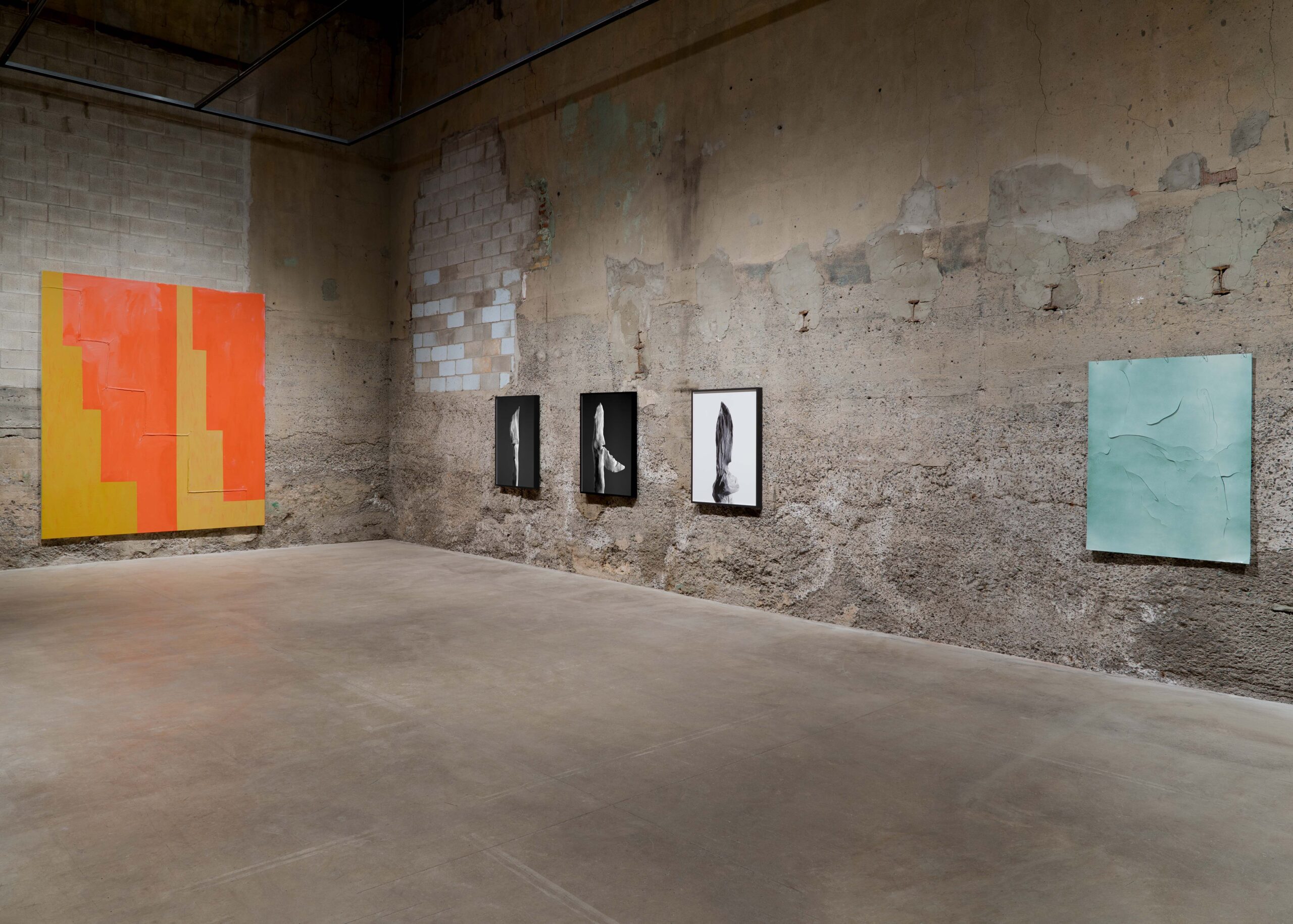 Champs de fracture, 2026. Exhibition view, Bradley Ertaskiran, Montreal (Canada). Photo: Jean-Michael Seminaro.
-
 Champs de fracture, 2026. Exhibition view, Bradley Ertaskiran, Montreal (Canada). Photo: Jean-Michael Seminaro.
-
Champs de fracture, 2026. Exhibition view, Bradley Ertaskiran, Montreal (Canada). Photo: Jean-Michael Seminaro.
-
 Champs de fracture, 2026. Exhibition view, Bradley Ertaskiran, Montreal (Canada). Photo: Jean-Michael Seminaro.
-
Champs de fracture, 2026. Exhibition view, Bradley Ertaskiran, Montreal (Canada). Photo: Jean-Michael Seminaro.
-
Champs de fracture, 2026. Exhibition view, Bradley Ertaskiran, Montreal (Canada). Photo: Jean-Michael Seminaro.
-
 Erin Shirreff, Knife, 2008. Archival pigment print, 101.6 x 76.2 cm (40 x 30 in.) Edition of 3 + 2AP.
-
Erin Shirreff, Knife, 2008. Archival pigment print, 101.6 x 76.2 cm (40 x 30 in.) Edition of 3 + 2AP.
-
Erin Shirreff, Knife, 2008. Archival pigment print, 101.6 x 76.2 cm (40 x 30 in.) Edition of 3 + 2AP.
-
Dawit L. Petros, Demarcation (Drawing a Line from Sand to Sea), Pointe Des Almadies, Dakar, Senegal, December 18, 2010, 2011. 3 archival pigment prints, 101.6 x 381 cm (40 x 150 in.) Edition of 3 + 2AP
-
Marie-Michelle Deschamps, Silhouettes (bis), 2025. Porcelain enamel on copper sheet, polished stainless steel, 121.9 x 91.4 cm (48 x 36 in.)
-
Shaan Syed, Double Minaret (with Sewn Steps) 1, 2018. Oil on sewn canvas, 288.3 x 237.5 cm (113½ x 93½ in.)
-
 Jeremy Shaw, Unseen Potential (Psilocybe Utopia, a.3), 2021. Kirlian Photograph, 67.7 x 52.7 x 5 cm (26⅝ x 20¾ x 2 in.), Edition of 1 + 1AP.
-
Jeremy Shaw, Unseen Potential (Psilocybe Tampanesis, a.2), 2021. Kirlian Photograph, 67.7 x 52.7 x 5 cm (26⅝ x 20¾ x 2 in.), Edition of 1 + 1AP.
-
Jeremy Shaw, Unseen Potential (San Pedro, a.3), 2021. Kirlian Photograph, 67.7 x 52.7 x 5 cm (26⅝ x 20¾ x 2 in.), Edition of 1 + 1AP.


