Tightrope
July 16th – August 29th 2026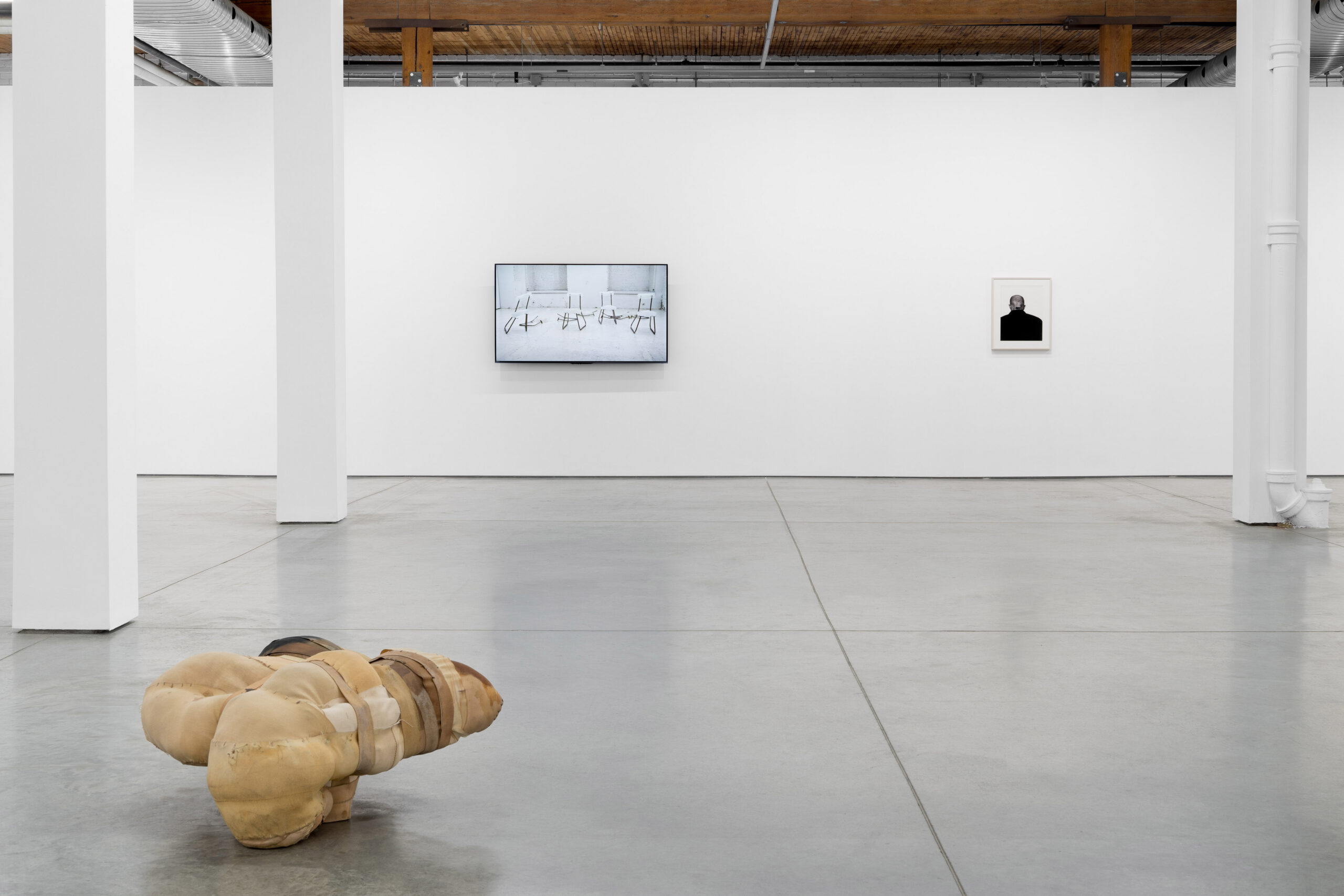
July 16 to August 29, 2026
Vernissage: Thursday, July 16, 2026, 5 to 8 pm
Sara Anstis
Patricia Ayres
Jeneen Frei Njootli
Suzy Lake
Jana Sterbak
Bradley Ertaskiran is pleased to present Tightrope, an exhibition bringing together local and international artists whose practices converge around constriction as both a psychological condition and a formal concern. This sense of constraint extends into material and technique alike: across photography, sculpture, drawing, and performance, the works gathered here are taut, wracked, inscribed, and occasionally on the verge of rupture, in an ever present state of tension.
For over four decades, Jana Sterbak’s work has probed the friction inherent in opposites, enveloping the viewer in juxtaposed sensations of attraction and repulsion drawn from granite, wire, ice, meat, bread, and a myriad of other provocative materials, worked through innovative sculpture, wearables, photography, and video. Dissolution (Auditorium) (2001), a study in corporeal and psychological will, toys with both torment and absurdity through precarious chairs made of ice and metal that gradually melt, their abandoned metal armatures eventually collapsing loudly onto the floor. Here and across her practice, transformative objects and materials become stand-ins for the human condition in its many contradictions: perfect yet flawed, vulnerable yet strong, free yet confined to fleshy, mortal coils.
Suzy Lake’s ImPosition series (1977) exemplifies her steadfast commitment to manipulating the photographic image, while underscoring larger questions of agency and control raised throughout her notable career. A series of black-and-white photos show Lake rope-bound in a starkly-lit, enclosed room, offering a claustrophobic sensation heightened by her having stretched the heat-softened film to varying degrees, warping and compressing the image plane as if the space was closing in around her. The rhythmic sequencing and the distorted verticality of the prints amplify Lake’s movement and struggle. The artist’s physical manipulation of the photographs—whose veracity was largely unquestioned in the 1970s—renders their representational nature both unstable and undeniable. Lake was never concerned with the formal purity championed by photographic purists of her time, but rather with how process could break down illusion, of both the self and its representation.
Patricia Ayres’ biomorphic sculptures hold their tension in the making as much as in the finished form. Drawing from her background in garment construction, Ayres manipulates and stitches elasticated fabric into patchy, bulging forms, which acquire fleshy qualities suggestive of swelling, scarring, and wear. Parachute hardware and butcher hooks add a tinge of violence and utility. The sculptures’ surfaces are further saturated with patchwork layers of pigment, ink, iodine, ash, anointing oil, and altar wine, the lumpen forms carrying traces of Catholic ritual and sacrifice. Her cryptic titles encode the names of martyred saints in numerical sequencing—not unlike reducing a person to an inmate number—positioning these works at the mysterious intersection of religious reverence, bodily suffering, and institutional control. Ayres’ creations are so tightly wound, so strained and swollen, that they strangely seem right on the precipice of transformation, of bursting apart and swallowing everything around them.
Jeneen Frei Njootli’s work is imbued with faint traces, subtle moments, and tactile impressions from something already passed. In their Knowledge Transference artworks (2017), cropped planes of flesh reveal delicate patterning created by pressing beadwork—made and gifted from family members—directly into skin. The resulting impressions are subtle but insistent, ancestral memory materialized and imprinted onto the body, made permanent through the photographic image before inevitably fading away. Absence and presence, erasure and transmission are central to Frei Njootli’s larger interdisciplinary practice, which incorporates culturally intimate materials and found objects drawn from the community they live and work within—the self-governing Vuntut Gwitchin First Nation—into sculpture, regalia, performance, and sound.
Sara Anstis works the surfaces of her pastel drawings with both softness and vigour, creating absorbing scenes that, despite their rich pigment and playful pastoral settings, generate a palpable, disquieting undercurrent. Closely-cropped compositions show fragments of women in mysterious, quotidian moments, their gestures and expressions hyper-aware and mischievous, as if we have interrupted them or invaded their personal space. Flesh is rendered with the polish of marble, hazy landscapes shimmer like mirages, and shape-shifting figures move through dream-like settings, where calm gives way to occasional ferocity and surprise. Bodies are often concealed and dislocated, framed through secret viewpoints and offset planes. The result is a heightened atmosphere ripe with intense observation, interrogation, and self-awareness, leaving Anstis’ characters and the viewer suspended between hesitation and thrill.
Artworks by Patricia Ayres courtesy of Matthew Brown, and artworks by Jeneen Frei Njootli courtesy of Macaulay + Co.
-
 Tightrope, 2026. Exhibition view, Bradley Ertaskiran (Montréal, CA), 2026.
-
 Tightrope, 2026. Exhibition view, Bradley Ertaskiran (Montréal, CA), 2026.
-
Tightrope, 2026. Exhibition view, Bradley Ertaskiran (Montréal, CA), 2026.
-
Tightrope, 2026. Exhibition view, Bradley Ertaskiran (Montréal, CA), 2026.
-
Tightrope, 2026. Exhibition view, Bradley Ertaskiran (Montréal, CA), 2026.
-
Tightrope, 2026. Exhibition view, Bradley Ertaskiran (Montréal, CA), 2026.
-
 Patricia Ayres, 19-1-13-16-19-15-14, 2023. Elastic, paint, ink, dye, anointing oil, sacramental wine, ashes, gunk, US Military elastic, padding, wood, 91.4 x 22.9 x 22.9 cm (36 x 9 x 9 in.)
-
 Patricia Ayres, 11-9-12-9-1-14, 2024. Elastic, paint, ink, dye, US Military parachute hardware, anointing oil, sacramental wine, US Military elastic, hitching post ring, padding, wood, 76.2 x 43.2 x 43.2 cm (30 x 17 x 17 in.)
-
 Patricia Ayres, 7-5-18-20-18-21-4-5, 2021. Elastic, paint, ink, dye, anointing oil, iodine, metal hardware, thread, wood, padding and foam, 36.8 x 83.8 x 88.9 cm (14½ x 33 x 35 in.)
-
 Tightrope, 2026. Exhibition view, Bradley Ertaskiran (Montréal, CA), 2026.
-
Suzy Lake, ImPositions FP4 Contact Sheet, 1977/2017. Chromogenic LightJet black and white print, 50.8 x 47.2 cm (20 x 18⅝ in.) Edition 2 of 5.
-
Suzy Lake, ImPositions #3, 1977/2015. Chromogenic LightJet black and white print, 171.1 x 88.9 cm (67⅜ x 35 in.) Edition 1 of 2.
-
Sara Anstis, Shower, 2026. Soft pastel on paper, 31 x 25 cm (12¼ x 9⅞ in.)
-
Sara Anstis, Mannequin, 2026. Soft pastel on paper, 44 x 33 cm (17⅜ x 13 in.)
-
Jana Sterbak, Vanitas: Flesh Dress for an Albino Anorectic, 1987. Colour photograph, 30.2 x 24.1 cm (11⅞ x 9½ in.) Edition 4 of 25.
-
 Jana Sterbak, Generic Man, 1987-89. Black-and-white photograph, 53.7 x 42.9 cm (21⅛ x 16⅞ in.), Edition 13 of 15.
-
Jana Sterbak, Dissolution (Auditorium), 2002. Video, sound, 12 minutes. Edition 2 of 3.
-
Jana Sterbak, Dissolution (Auditorium) 1, 2, 3, 2002. 3 Chromogenic prints, 30.5 x 40.6 cm; 40.6 x 30.5 cm; 30.5 x 40.6 cm (12 x 16 in.; 16 x 12 in.; 12 x 16 in.)
-
Jeneen Frei Njootli, Knowledge Transference I, 2017.Archival ink on vinyl, metal hardware, 132.1 x 90.2 cm (52 x 35½ in.), AP1, Edition of 3, 2AP.
-
Tightrope, 2026. Exhibition view, Bradley Ertaskiran (Montréal, CA), 2026.
-
Jeneen Frei Njootli, Knowledge transference II, 2017. Archival ink on vinyl, metal hardware, 88.9 x 132.1 cm (35 x 52 in.)


